|
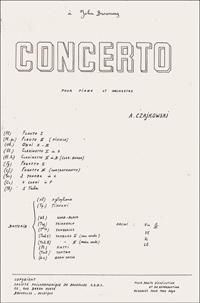
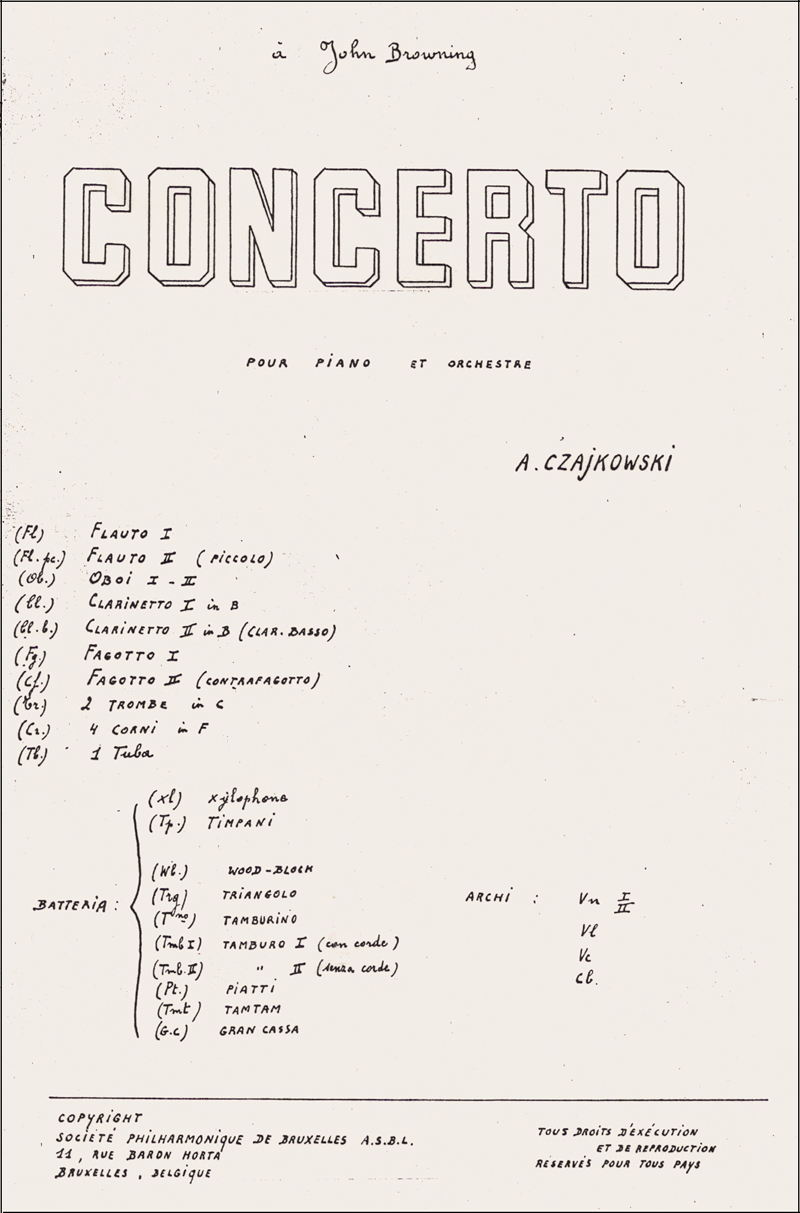
Cover Sheet
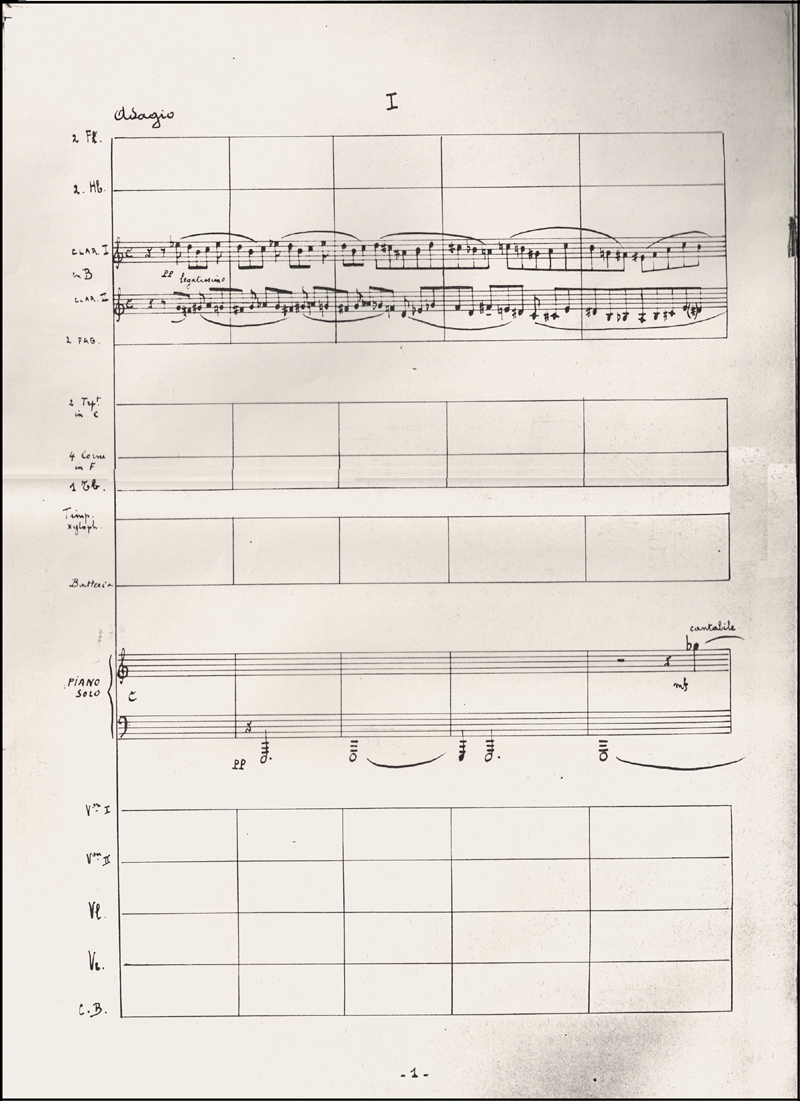
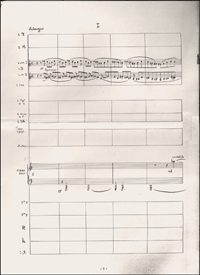 First Manuscript Page
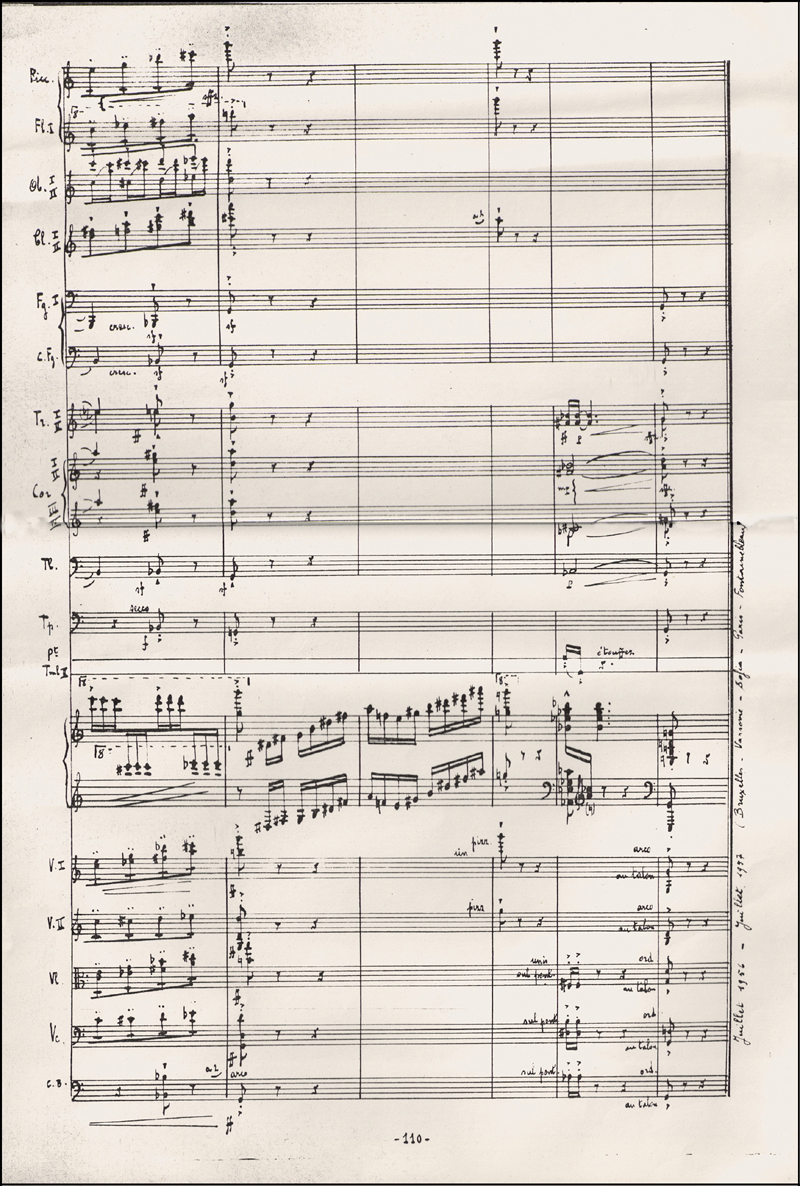
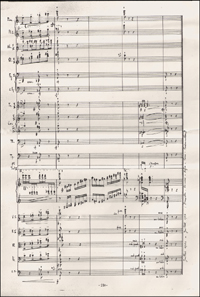 Last Manuscript Page
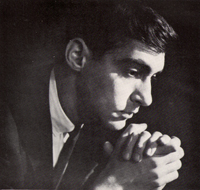
Dedicated to pianist,
John Browning (1956)
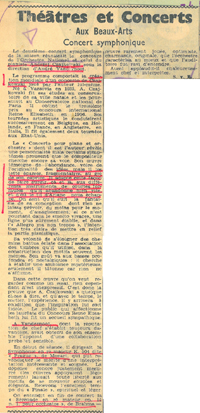
Review
1 (in French)
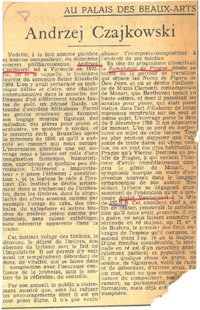
Review
2 (in French)
|
Piano
Concerto (1956-1957)
This
webpage provides information about the André Tchaikowsky early
Piano Concerto (1956-1957). First are music links (as *.mp3 files) and
then text that lists all known details regarding this composition, including
performances to date, plus text about the concerto from the book, The
Other Tchaikowsky - A Biographical Sketch of André Tchaikowsky.
The
Music
The piano concerto was recorded as a private label vinyl record, which
lacks good sonic qualities but one can get an idea of the composition.
The concerto is in four movements, as listed below as *mp3 files. At
times, you will notice André making humming noises. A special
note of "thanks" to pianist Michal Wesolowski for sharing
his digital copy of this record and to the recording engineer, Johan
Bejerholm of World Studios (Malmö, Sweden).
Piano
Concerto (1956-1957)
Belgium National Orchestra
André Tchaikowsky - Piano | André Vandernoot - Conducting
Brussels, Belgium (Sunday, 16 March 1958)
00_a_czajkowski_early_pf_concerto_complete.mp3
01_a_czajkowski_early_pf_concerto_1st_mvmt.mp3
02_a_czajkowski_early_pf_concerto_2nd_mvmt.mp3
03_a_czajkowski_early_pf_concerto_3rd_mvmt.mp3
04_a_czajkowski_early_pf_concerto_4th_mvmt.mp3
Newspaper
Reviews
There were two newspaper reviews of the 18 March 1958 performance,
which was the 12th concert in the 1957-1958 season for the Belgium National
Orchestra. For the original French, see the links on the left.
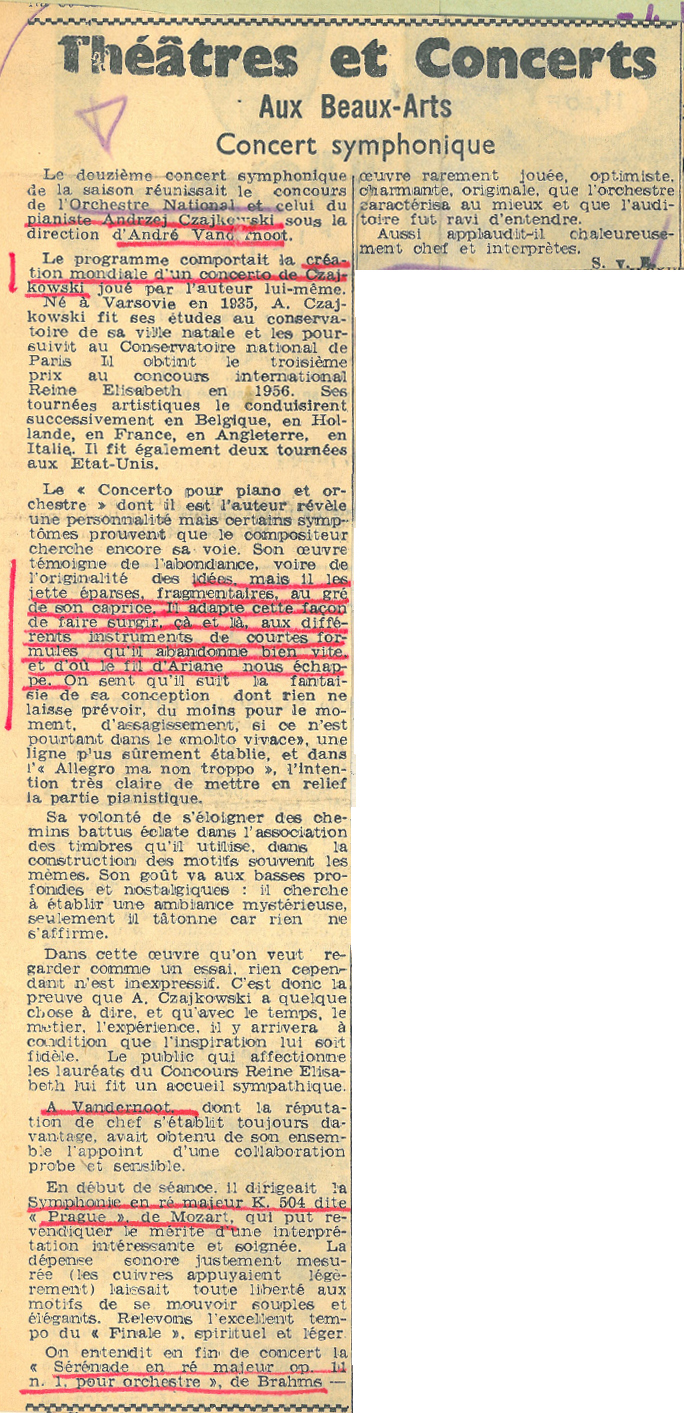
Theatres
et Concerts
Aux Beaux-Arts
Concert Symphonique
The twelfth
symphony concert of this season brought together the forces of the
National Orchestra and the pianist Andrzej Czajkowski, all under the
direction of André Vandernoot.
The program
included a world event, a concerto by Czajkowski and played by the
composer himself. Born in Warsaw in 1935, A. Czajkowski first studied
at the conservatory in his hometown and later continued at the National
Conservatory of Paris. He won the third prize at the Queen Elisabeth
International in 1956. His artistic tours led him successively in
Belgium, Holland, France, England, and Italy. He also engaged in two
tours in the United States.
The "Concerto
for Piano and Orchestra," of which he is the composer, reveals
a distinct personality but certain signs indicate that the composer
is still finding his voice. His work testifies to an abundance of
original ideas, but he throws them scattered and fragmentary, according
to his whim. In this way he adapted the different instruments in short
combinations that were soon abandoned, leaving a bread crumb trail
that we could not follow. This gave us the feeling that his fancy
design was leading nowhere, at least for some moments. This sobering
effect was not found in the “molto vivance” but it surely
appeared in the “Allegro ma non troppo,” where there was
a very clear intention to highlight the piano part.
His desire
to stay strictly on the beaten path exploded with the association
of tones he used in the construction of patterns, which were often
the same. He wanted us to taste what is deep and nostalgic - seeking
to establish a mysterious atmosphere, but he just groped around and
nothing was said.
In this
work we should think of this as a test, and it is not without value.
There is evidence that A. Czajkowski has something to say, and with
time, labor, and experience, he will come to a point of faithful inspiration.
The public shows great affections for the winners of the Queen Elisabeth
Competition and they gave him a warm welcome.
A. Vandernoot,
who reputation as a leader was further established, led his ensemble
with extra collaboration of probing and sensitivity.
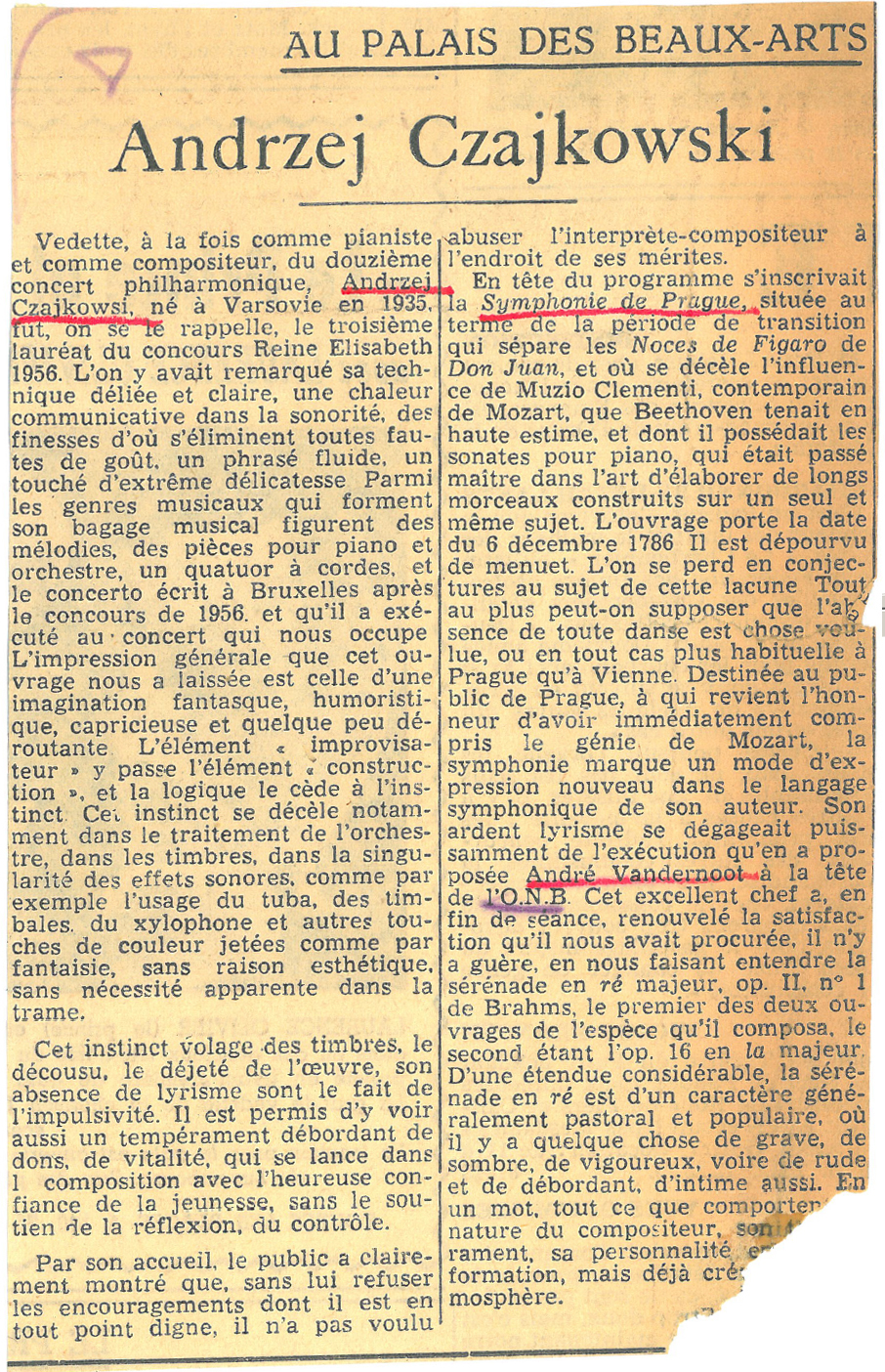
AU
PALAIS DES BEAUX-ARTS
Andrzej Czajkowski
Spotlight
on both pianist and composer for the twelfth Philharmonic concert,
was Andrzej Czajkowski who was born in Warsaw in 1935 and was, as
we remember, the third prize winner of the Queen Elisabeth Competition
in 1956. There it was noted that his technique was clear, it communicated
warmth, had subtleties without errors, had fluid phrases, and a touch
of extreme delicacy. Among the musical genres that form his musical
background, you can include songs, pieces for piano and orchestra,
a string quartet, and a concerto written after the competition in
Brussels in 1956, given in this concert.
The general
impression of this work is one of whimsical imagination, humorous,
but somewhat bewildering because the logical elements of composition
yield to instinct. This instinct reveals itself especially in the
treatment of the orchestra, of sound effects such as the use of tuba,
timpani, xylophone and other splashes of color thrown in like a whim
of fantasy, seemingly without any aesthetic reason, and without any
apparent framework.
This
instinct changes the sounds, shows the disjointed, lopsidedness of
the work, and its lack of lyricism because of impulsiveness. But it
is also possible to see a temperament that is overflowing with gifts,
of a vitality that launches this composition with the happy confidence
of youth, without any constraints of reflection or control.
By his
reception, the public clearly knows that encouragement will not be
refused, that he is in every way worthy, and surely will not abuse
the composer-performer against its merits.
From
the biography The
Other Tchaikowsky
The very first mention of a piano concerto is when Andrzej requested
a commission and a subsidy from the Polish Composers' Union on January
5, 1951 - He was 15 years old.
To: Polish
Composers' Union, Warsaw
Fm: Andrzej Czajkowski, 7 Dabrowskiego Street, Apartment 3, Sopot
I wish
to inform you about my composition projects:
a. Piano
Etudes - A series of 12 piano etudes to be used at the higher music
schools, in which I touch upon new piano techniques and rhythm problems.
I think I can complete this work by the beginning of April 1951, but
not later than the end of April 1951.
b. Piano
Concerto - A piano concerto will be written in F-minor, accompanied
by an orchestra, enlarged. The tempo is still something I have to
determine. The concerto movements shall be allegro, moderato, andante
spianato, and scherzo.
c. Flute
Concerto - A flute concerto will be written to use in a natural way,
that is, in the original scale.
The piano
and flute concertos will be finished by the end of the next academic
year, or at least one of them will be done. I wish the Union to commission
these works and grant me a subsidy, which will allow me to finish
one or both of the above-mentioned compositions.
Yours,
Andrzej Czajkowski
The concerto
is mentioned again in 1957, after study with Nadia Boulanger. The concerto
is dedicated to pianist John Browning, whom André met at the
1956 Queen Elisabeth Piano Competition.
Piano
Concerto (1956-1957)
The piano
concerto promised to John Browning was completed at Fontainebleau in
July, 1957, and first performed on March 18, 1958, with the Belgium
National Orchestra conducted by André Vandernoot. André
Tchaikowsky was the piano soloist. The score is dated, "Juillet
1956 -- Juillet 1957 (Bruxelles -- Varsovie -- Sofia -- Paris -- Fontainebleau)."
André had hoped that Browning might have considered giving the
first performance, but he wasn't interested in the concerto.
André
describes his composition in a letter to Halina Wahlmann (now Halina
Wahlmann-Janowska) on June 18, 1957:
Dear
Pussycat,
My little
kisser, I'm very worried about you, and I myself am going through
a difficult time. I have to do everything at once -- finish my concerto
by the first of August, record three long playing records: Gaspard
de la Nuit, Visions Fugitive, Goldberg Variations, Bach's three preludes
and fugues, plus six Scarlatti sonatas.
I visit
the Rubinstein's every day, which is far less fun than it would seem.
Mr. Rubinstein is very much interested in my piano concerto and he
says that it will be Bartok's fourth concerto (he doesn't like Bartok).
He gave me the following advice: "Open up! Let your soul sing!
You're very talented, child, a golden talent. You should write as
to make everybody in the audience cry." But I doubt if I'm going
to listen to him. I could end up with the fifth concerto by Rachmaninoff.
My conductor, the handsome André Vandernoot, gives me the opposite
advice: "Oh, such a beautiful theme! Isn't it a waste to use
it for the piano? Turn it into a symphony. What do you need this typewriter
for? It was fashionable during its era. In ten years' time, almost
nobody will be playing it. Listen mate, the orchestra plays much better
when no twiddle, twiddle interrupts her."
Under
Rubinstein's influence I wrote a theme, which all my friends consider
to be terribly sweet and weepy. Under Vandernoot's influence, I added
accompaniment on the post twelve-tone series with "concrete"
whispers on percussion, pianissimo kettle drums, glides and trills
in the quarter tones. God only knows how it's going to turn out, but
I'm looking forward to the first performance, and I feel we are all
going to have a lot of fun.
I can
just imagine the look on the faces of the orchestra during the first
rehearsals. (By the way I'd like to have you there.) It will be nothing
less than a zoological symphony: Drums growling, clarinets meowing,
brass roaring, and flutes barking. But the real menagerie will be
the audience.
My love,
it's already past four, and at five I begin recording. Let me be blessed
by God, because I don't know what I shall be doing. Hopefully, I'm
not the only one. A few days ago I went to a concert given by C. P.
who plays and looks like an old, used-up French letter. Men of learning
find in him a certain resemblance to Rameses II, but it must be said
that the Egyptian civilization has so far fared better. It didn't
cross anybody's mind to mummify C. P. when there was still time for
it. As of now, I'm seriously afraid it's too late, both for him, as
well as for Mrs. M.L. [Marguerite Long], who, for a change, in terms
of her face, resembles Moby Dick. The only one that holds his age
quite well is King Arthur [Rubenstein].
Well,
be well, be well. Aunt Mala keeps hurrying me up, bangs me on the
back, pulls my hair so as to make me hurry up, because you should
know, I'm still in my pajamas. I kiss you a thousand times.
Yours,
André
After the
premiere performance, the work was never played again.
The complete
score is in the Josef Weinberger André Tchaikowsky archives.
A complete copy of this early piano concerto is in the library at the
Royal Conservatoire of Antwerp, Belgium. This copy originally was given
by André to Marcel Cuvelier who, at the time, was the jury president
for the 1956 Queen Elisabeth Piano Competition, where André received
3rd prize.
|